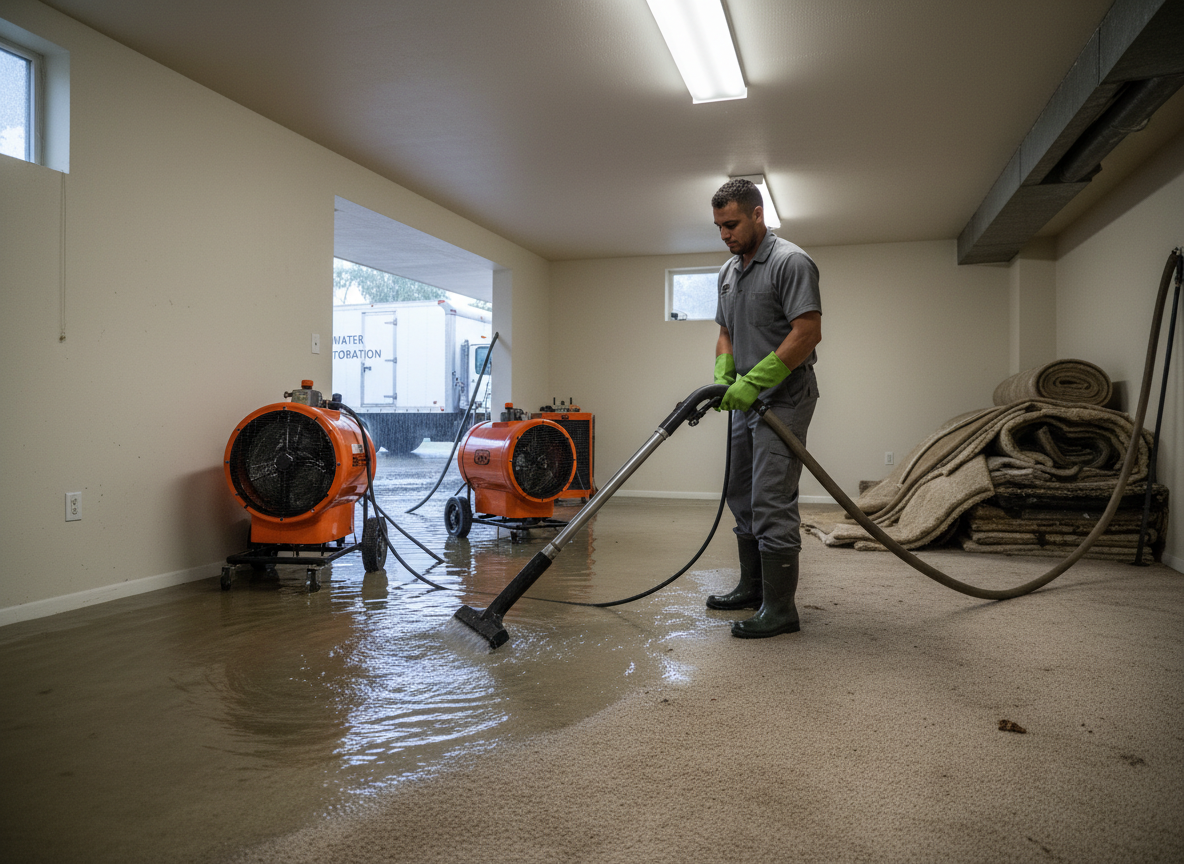
Chatsworth sits in a Mediterranean climate where hot dry summers give way to occasional winter downpours that overwhelm older drainage around Santa Susana Pass State Historic Park and Orcutt Ranch. Homes built on the area's clay-heavy soils in the 1950s and 1960s often have shallow foundations that let water migrate under slabs in West Chatsworth and Downtown Chatsworth. Emergency water removal here starts with locating hidden moisture pockets before they reach adjacent Northridge or Canoga Park properties.
Technicians use truck-mounted extraction units rated for high-volume removal because even a modest kitchen leak can push several hundred gallons into crawl spaces beneath ranch-style houses common in Chatsworth Park. Edge cases include water trapped behind stucco walls or under tile in bathrooms where the original vapor barriers have failed. Los Angeles County building codes require documented moisture readings below 15 percent before any wall cavities are closed, so crews log readings at multiple depths during every job.
Terrain plays a direct role near the Santa Susana foothills where runoff from higher elevations funnels toward lower lots in West Chatsworth. Crews often encounter pressurized water under driveways that must be relieved before drying equipment can work effectively. Failing to address this hydrostatic pressure leaves residual moisture that later migrates into neighboring Simi Valley homes through shared grading.
Technician insight
In Chatsworth the thing that catches most people out with emergency water removal is the way winter rains pool against the shallow foundations of 1960s homes near Chatsworth Park South; the clay soil holds water for weeks and pushes it under slabs long after the rain stops, so extraction alone rarely finishes the job without extended drying under the concrete.
Slab leak after winter rain in West Chatsworth
Water appeared under the kitchen tile of a 1962 ranch house in West Chatsworth following a December storm. Extraction revealed seepage traveling under the slab from the direction of higher ground near Santa Susana Pass. Crews removed standing water, mapped moisture through the concrete, and ran drying equipment beneath the floor for six days until readings dropped below threshold.
How it works
- 1
Arrival and Containment
Technicians arrive within the hour, shut off water sources if still active, and set up barriers to prevent spread into unaffected rooms.
- 2
Extraction
High-capacity pumps and wands remove standing water from floors, carpets and subfloors while documenting volumes removed.
- 3
Moisture Mapping
Infrared cameras and pin meters locate hidden moisture in walls, cabinets and concrete slabs common in Chatsworth ranch homes.
- 4
Initial Drying Setup
Air movers and dehumidifiers are placed based on the mapped moisture, with daily readings logged until levels stabilize.
Pricing
Upfront quotes provided after inspection; final cost depends on water volume, affected square footage and drying duration.